
Standing all day at a standing desk sounds like the cure for a sore back, but it isn't. A University of Sydney study of 83,013 UK adults found that standing more didn't lower the risk of heart disease or stroke. It was linked with more circulatory problems such as varicose veins.
The answer is to keep moving between sitting and standing throughout the day for better posture and comfort. The NHS advice on sitting less is to break up long spells in a chair. A standing desk makes that easy. So you'll still spend part of the working day seated. When you do, you want a chair that fits the desk at its sitting height and gets out of the way when you stand again.
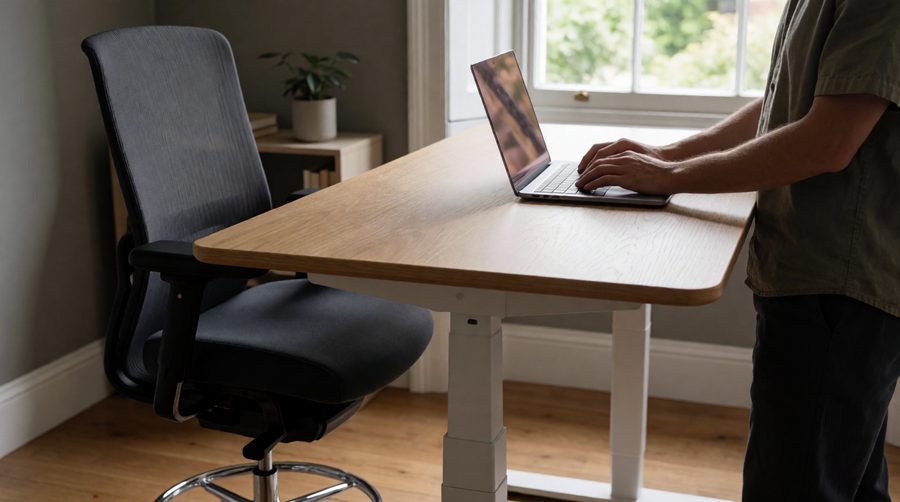
There are four main ways to sit at a sit-stand desk. Which one suits you comes down to how long you sit and whether you lower the desk when you do.
If your standing desk drops to normal desk height (around 72 to 74cm), a good ergonomic office chair is the comfiest choice. You get a full backrest, lumbar support and armrests for long spells of work at the keyboard. Our picks are all task chairs with a gas lift, a swivel base and castors, so you can glide away as the desk rises.
A drafting chair is a tall desk chair with an adjustable height range that starts higher, plus a longer gas lift and a foot ring. It lets you sit at a desk that stays high, a kitchen counter or a reception desk. At drafting height your feet won't reach the floor, so the ring takes their weight instead. Most also have flip-up arms that won't catch the edge of a raised desk.
A perching stool, sometimes sold as a standing desk stool, tilts you forward into a half-standing position with your feet still on the floor. It's an active way to rest your legs at a standing desk for ten minutes rather than settle in for an hour. Saddle seats and wobble stools sit in this group too. They're light and small, so they slip under the desk when you're done.
A kneeling chair angles your hips forward and shares your weight between the seat and your shins. It's better for short sessions at a lowered desk than for all-day sitting. Browse our ergonomic kneeling chairs if you like the idea of a more upright posture.
Start with the desk, not the chair. The HSE guide to good posture at a screen says your keyboard should sit just below elbow height and your seat should support the front and back of your thighs evenly. Leave a gap of 2 to 3cm between the front of the seat and the back of your knees.
A handy rule is to set the seat about 25 to 30cm below the desk top. So a desk lowered to 73cm pairs with a seat around 45 to 48cm, which every chair here can reach. For a desk left at 105cm you'd want a seat of roughly 75 to 80cm. That's drafting chair territory. It's also why a normal task chair won't work at a raised desk.
If your feet don't sit flat on the floor once the seat is right for the desk, use a footrest. The Newtral NT002 has a foldable footrest that tucks away. The Efomao 3084UK comes with a separate ottoman.
Every figure comes from the maker's listing on Amazon. Chair weight matters more than you'd think, because you'll be moving the chair each time the desk goes up.
| Chair | Seat height (cm) | Lumbar support | Armrests | Weight capacity | Chair weight |
|---|---|---|---|---|---|
| FlexiSpot ErgoX | 9cm of travel | 5D adaptive | 3D | 130kg | 15kg |
| Office Hippo Heavy Duty | 47 to 56.5cm | Curved back | Height adjustable | 152kg | 23.5kg |
| Newtral NT002 | 45cm (adjustable) | Dynamic, with dial | 4D | 136kg | 26kg |
| Hbada E3 Ultra | Gas lift | 3 zone, 8 way | 360 degree | Not listed | 31kg |
| Steelcase Please | Pneumatic | Adjustable | 4D | Not listed | 20.45kg |
| Fractal Design Refine | Gas lift | Adjustable | 4D | 125kg | 25.7kg |
| Efomao 3084UK | 48cm, 5 positions | Padded back | Height adjustable | 200kg | 24.95kg |
The ErgoX stands out for standing desk users because it's the lightest by some way. If you're a bigger build, the Efomao takes up to 200kg and you'll find more like it in our big and tall ergonomic chairs.


A standing desk chair gets moved, raised and lowered far more than one at a fixed desk. These are the details worth checking.
Look at the lowest and highest seat height, not just the word "adjustable". A wider range lets you match the chair to the desk and to anyone else who shares it. A tested gas lift, like the Newtral's SGS Level 4 cylinder, is built to cope with frequent changes.
An armrest that won't drop low enough stop you pulling in close, which leaves you leaning forward. 4D arms on the Newtral, Steelcase and Fractal chairs move up, down, in and out. On a drafting chair, flip-up arms do the same job.
Smooth castors let you roll the chair aside in one push. A 15kg chair like the ErgoX is far easier to move than the 31kg Hbada E3 Ultra. If you'd rather your chair stayed put, our comfortable desk chairs with no wheels are worth a look.
You'll probably sit for shorter spells at a standing desk, but those spells still need proper back support. Lumbar support you can tune helps you hold a good posture when you're tired at the end of the day. A headrest is useful if you lean back to read or take calls. Our computer chairs with headrests all have one.
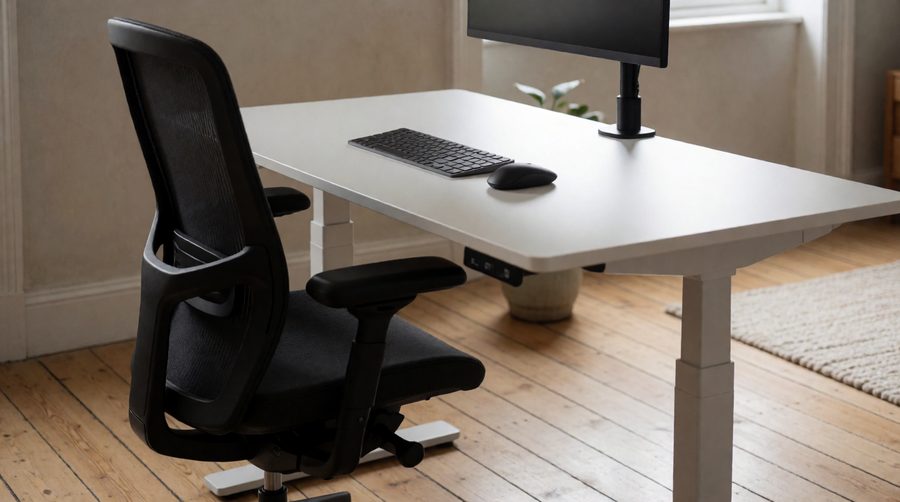
Before you buy, run through these points with your own desk in mind.
Mesh lets air through, so a mesh desk chair stays cool if you're up and down all day. The ErgoX, Newtral and Hbada all use it. Our ergonomic mesh chairs have plenty more. Fabric, like the wool-rich cover on the Steelcase Please, feels softer and wears well. Faux leather wipes clean and suits drafting chairs at a counter, so see our leather office chairs if that's your style.


Lower the desk and sit with your arms relaxed and your elbows at about 90 degrees. Raise or lower the seat until your thighs are level, then bring the desk to just below your elbows. Note that height so you can return to it with a preset button.
Check the arms slide under the desk top and that the legs or crossbar don't get in the way of your knees. Leave enough floor space to roll the chair clear when you stand. The HSE workstation checklist is a quick way to check the whole setup, especially if you work from a home office.
There's no set rule on how long to sit or stand. Change position when you start to feel stiff and take short walks when you can. On a budget? Our affordable ergonomic office chairs pair well with a standing desk too.
Yes, as long as you lower the desk to seated height first. A height-adjustable task chair with castors works well. It only falls short if you want to sit while the desk stays high, which is where a drafting chair comes in.
Measure the desk at the height you'll sit at and take off a hand span or two. Most people at a desk lowered to 73cm sit comfortably on a 45 to 48cm seat. A desk kept high needs a drafting chair that reaches much further.
They're great if you keep the desk high or work at a counter. The foot ring supports your feet and flip-up arms clear the desk edge. For long seated spells at a lowered desk, a task chair with a full backrest is usually comfier.
For short breaks, it can be. A perching stool keeps you active and half standing, but it doesn't give your back the rest a proper chair does. Many people keep both in the office. The stool covers active breaks while the ergonomic chair handles longer work.
There's no single schedule that suits everyone throughout the day. Move whenever you feel stiff and avoid long spells in any one position, sitting or standing.
