
Our desk chairs without wheels are for anyone who wants a seat that stays exactly where they put it: home workers on wooden floors, students at a bedroom desk, and anyone who sits cross-legged and is tired of a chair rolling away mid-call.
With no castors underneath, these chairs sit on fixed legs, a sled frame or a weighted swivel base, so they won't scratch laminate or creep across a rug. Need a more adjustable chair for long days? Compare them with our office chairs with adjustable lumbar support.
Castors are handy in an open-plan office, where you roll between a desk, a printer and a filing cabinet. At home they are often more of a nuisance. A desk chair with no wheels fixes the most common complaints:
The trade-off is adjustment. Many chairs with no wheels have a fixed seat height and simpler backs, so this guide shows you which designs still give proper support for a working day.
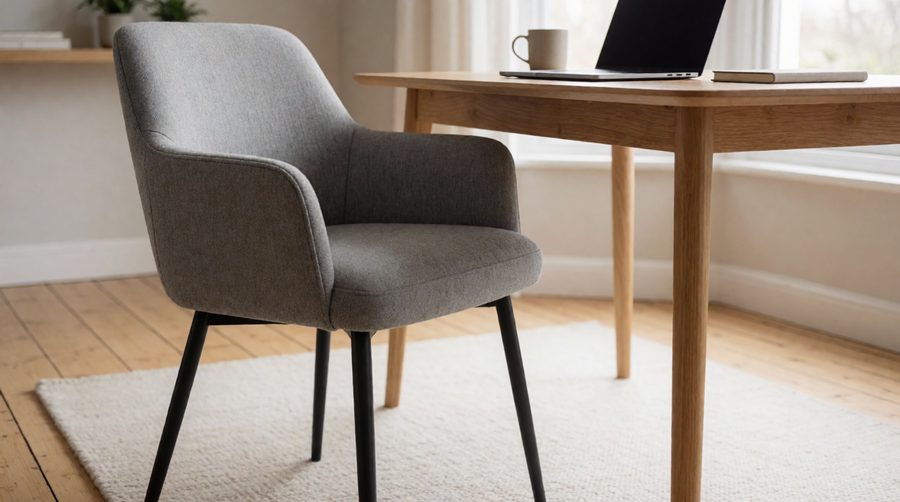
The base decides almost everything: whether the chair swivels, whether the seat goes up and down and how it behaves on your floor. Here is how the five main designs compare.
| Base type | Swivels? | Height adjustable? | Best floor | Best for |
|---|---|---|---|---|
| Four legs | No | Rarely - usually a fixed seat height | Wood, laminate, tiles (with felt pads) | Bedroom desks, living room home offices, vanity seats |
| Sled / cantilever | No | No | Carpet and hard floors - the frame spreads the weight | Meeting rooms, visitor seats, short desk sessions |
| Spider (four-star) base on glides | Yes, 360° | Sometimes | Hard floors and low-pile carpet | Stylish home offices that still need a swivel |
| Round pedestal base | Yes, 360° | Often, with a gas lift | Any floor | Cross-legged sitters, bedrooms, shared desks |
| Five-star base with glide feet | Yes, 360° | Yes, plus tilt and lumbar on many | Any floor | Full working days at a desk |
The classic dining-chair layout, usually metal or wood legs under a padded, upholstered seat. Four-leg designs are steady, light enough to lift and look the most like home furniture. Most have a fixed seat height and don't swivel, so check the height against your desk before buying.
A sled base is a continuous loop of metal tube that runs along the floor on each side. It spreads the load, slides a little when you push back and is the usual choice for meeting room and visitor seating. A cantilever frame has no back legs at all, which gives a slight springy flex as you lean.
A spider base has four splayed metal legs meeting under the seat, often in chrome, black or a brushed finish, with fixed glider feet instead of castors. You get a full 360° swivel, and it's the look many UK furniture shops use for stylish home office chairs.
A round, weighted metal disc with a central column. It swivels without rolling, and many are height adjustable with a gas lift, just like a normal office chair. This is the closest thing to a standard computer desk chair with no wheels: a swivel chair that stays where it is.
Some chairs keep the familiar five-star base but use fixed glide feet in place of castors. They keep the full set of ergonomic adjustments (height, tilt, lumbar support) and simply stop the chair moving.
A newer style built for sitting cross legged: an extra-wide, deep seat, a low curved back and usually no arms, so your knees have room. Popular for gaming, reading and anyone who fidgets.
Comfort for desk work comes down to fit and support. The Health and Safety Executive's guide to good posture at a workstation sets out the basics, and they apply to any chair, wheels or no wheels.
The HSE advice is a seat height that keeps your forearms roughly horizontal at the keyboard, with your feet flat on the floor or on a footrest. On a fixed-height chair you can't fine-tune this, so measure: sit on a chair you like, measure from the ground to the top of the cushion, and look for that figure in the listing. If you're between sizes, a cushion raises you and a footrest helps if your feet don't reach the floor.
Leave a few centimetres between the front of the seat and the back of your knees. Too deep and you'll slump; too shallow and your thighs aren't supported. A wider seat helps if you like to tuck your legs up.
A backrest that curves into your lower back stops you rounding forward. Fixed-leg chairs often have a shaped back rather than an adjustable one, so sit back and check where the curve lands. For full days look for a separate lumbar pad, or see our adjustable lumbar support range. The NHS advice on back pain explains when aches need checking.
An armrest takes weight off your shoulders and helps you stand up. Armless chairs tuck fully under the desk, save space and leave room for sitting cross legged. Flip-up armrests give you both.
Fixed bases are usually very stable, but always check the rated load in kg. Many home chairs are rated around 110-120kg; for more, see our big and tall office chairs.
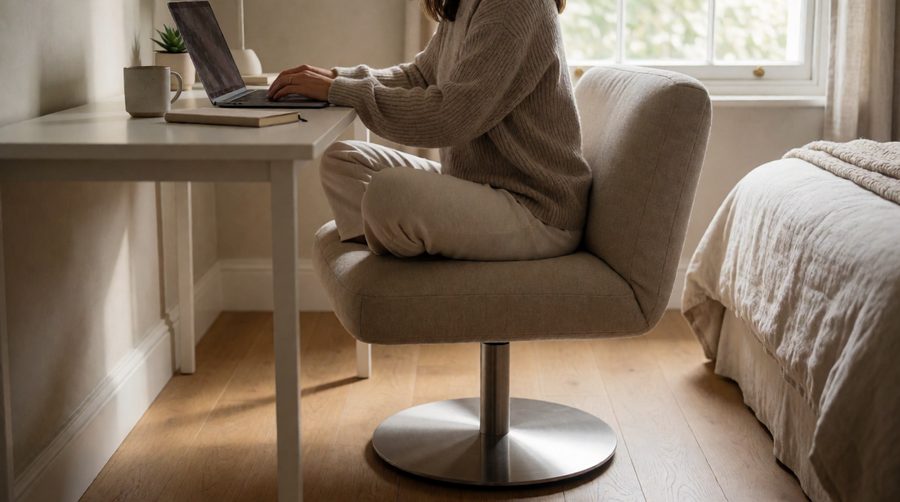
Because a desk chair no wheels often sits in a living room or bedroom rather than an office, the look matters as much as the fit. The main styles you'll see:
Brands such as HOMCOM, Vinsetto and Costway sell many of these designs on Amazon UK, alongside furniture-shop names. Most arrive flat-packed, but assembly is quicker than a standard office chair because there's no gas lift, tilt unit or castors to fit on a legged model.
One of the main reasons people look for an office chair no wheels design is the floor.
If the legs are bare metal, add stick-on felt pads before first use and replace them when they wear thin.
A chair with no castors isn't right for everyone, so it's worth knowing the limits:
Often, yes. Most office chair castors push into the base on a standard stem, commonly 11mm wide, and pull out with a firm tug. Replacement glide feet with the same stem turn a wheeled chair into a stationary one in minutes. Check your chair's stem size before ordering, and note that swapping parts can affect the warranty on some chairs.
Prefer something different again? A kneeling chair has no back at all and tilts you forward, a computer chair with a headrest supports your neck when you lean back, and our affordable ergonomic office chairs cover the budget end.
Not in themselves. What matters is the fit: seat height, seat depth and support in the lower back. A stationary chair can be just as good as a wheeled one if it fits you and your desk.
Yes. Spider, pedestal and five-star bases with glides turn a full 360°. Four-leg and sled chairs usually don't swivel.
Very. Without castors there's nothing to dig in or roll, so you don't need a chair mat. A sled base or wide feet stop the legs sinking.
Not if the feet are capped. Use felt pads on wood and laminate, and check them every few months.
It can be, if it has a supportive back and the right seat height. For six hours or more, pick a fully adjustable ergonomic desk chair on glide feet rather than a fixed four-leg design.
Enough for your forearms to sit roughly level at the keyboard with your feet flat. Measure a chair that feels right and match it, as many chairs without castors are fixed height.
Yes, if the seat is wide enough. Look for a criss cross or wide-seat design, ideally armless or with flip-up arms.
