
An ergonomic kneeling chair swaps the flat seat and backrest of a normal office chair for a seat that slopes forward and a lower pad for your shins. You are not kneeling in the usual sense when sitting on one. You do not rest your full weight on your knees. Most of it stays on your bottom. Your shins rest on the pad and stop you sliding forward.
That simple change moves your thighs down from level. The angle between your body and your thighs opens from about 90 degrees to about 110 to 120 degrees. Your pelvis tips forward, and your lower back keeps the gentle S-curve your spine has when you stand. This is often called active sitting. The seat on most models slopes at 20 to 30 degrees.
The idea is Norwegian. Hans Christian Mengshoel worked out the principle, and in 1979 designer Peter Opsvik created the Variable Balans, the rocking stool that Varier still makes today. Most ergonomic kneeling chairs sold now are versions of that layout.
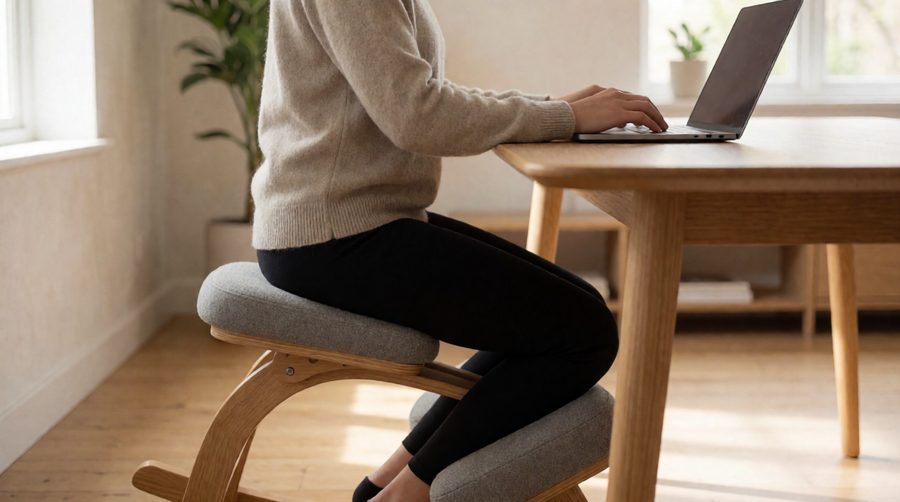
People buy one to improve their sitting posture and slump less. Here is what the design does well:
A kneeling chair is not a medical treatment. If you have ongoing pain, read the NHS advice on back pain and speak to a GP or physio before you change how you sit.
Kneeling stools are not for everyone. Testers and physios raise the same points:
If you are over about 1.9m or over 120kg, you will be more comfortable in one of our big and tall office chairs.
Every kneeling chair uses the same sloped seat and shin pad. What changes is the base under it and whether it has a back.
These sit on two curved wooden runners, like a rocking chair. You rock forward to type and back to read. Testers at BTOD found the flex and movement in a wooden rocker was the main reason they stayed comfortable for longer than 30 to 60 minutes. The downside is that you cannot roll around the desk. The Predawn, Varier and TinyHaven in our range all rock.

A fixed frame stands still on four feet. It feels steadier for close, detailed work like drawing or sewing, and holds your posture in one place. Height is set by a tilt or a slot in the frame rather than a gas lift. The Cinius is a good example, with a rubberwood frame and no wheels.
Some models use a steel X-frame or a five-star base with wheels and a gas lift. They roll and adjust more easily, which suits shared desks and hot-desking in an office. They are stiffer, though, so you move less while seated. None of the kneeling chairs on castors we checked passed our 4-star bar and were in stock.
A backrest gives you somewhere to lean when your core tires. That makes the chair more comfortable for longer if you are new to kneeling, and it still protects your lower back posture. The LXX in our grid adds a padded back to a rocking kneeling base.
All figures for these ergonomic kneeling chairs come from each maker's listing. Depth matters, as rockers need more floor space than fixed stools.
| Chair | Base | Backrest | Adjustment | Max weight | Size (D x W x H) |
|---|---|---|---|---|---|
| Cinius | Fixed, rubberwood | No | Seat-to-knee tilt | 100kg | 54 x 45 x 51cm |
| Predawn | Rocking, solid wood | No | Seat height | 120kg | 85 x 55 x 54.5cm |
| Varier | Rocking, wood | No | Not listed | 110kg | 72 x 52 x 51cm |
| TinyHaven | Rocking, solid wood | No | 24 angle settings | 113kg | 80 x 55 x 50cm |
| LXX | Tube legs, non-slip | Yes, padded | Adjustable | 100kg | 78cm tall |
The Predawn has the highest weight limit and the thickest listed foam at about 8cm. The Cinius is the most compact. The TinyHaven offers the most settings, and the LXX is the only one with a back.

Prefer a conventional seat that still helps your posture? Our ergonomic mesh office chairs and affordable ergonomic office chairs give you lumbar support, wheels and armrests.

Most ergonomic kneeling chairs end up in a home office rather than a big open-plan floor. They are quiet, compact and look more like furniture than a typical ergonomic chair. A wooden rocker suits a spare room or a desk in the corner of a lounge.
They also work well for study. Students who hunch over a laptop find the forward slope keeps their posture taller through long reading sessions. Set the screen high and use a separate keyboard if you can.
Meditation is the third common use. The kneeling position keeps your back straight without leaning on anything. The Predawn and TinyHaven are both sold for meditation as well as desk work. A thick cushion on the seat and knee pads matters more here, as you sit still for longer.
Whatever the use, the rule is the same. Mix your sitting positions through the day. A kneeling chair is one good posture among several, not the only one you need.
Set-up takes a minute and makes all the difference to sitting comfort and posture on ergonomic kneeling stools.
Start with 20 to 30 minutes of sitting at a time and build up over a week or two. Swap between the kneeling stool, a normal chair and standing. The HSE guide to good posture at a workstation covers screen and desk set-up that applies here too.
Pairing it with a sit-stand desk works well. Our adjustable standing desk chairs page covers perching stools for the standing half of the day.

Some people find ergonomic kneeling chairs hard going. Think twice if you have:
The Chartered Society of Physiotherapy has free exercises for back pain if you want to build strength alongside a better sitting posture. If kneeling is not right for you, an ergonomic executive office chair with a reclining back or one of our office chairs with headrest will give you full support instead.
They can help if you slump. The open hip angle keeps your lower back closer to its natural curve and takes some strain off your spine. But they are not a cure. Some people with back pain find them worse. Try one for short spells and see how you feel.
Start with 20 to 30 minutes and build up. Many users settle at a few hours a day, mixed with a normal chair or standing. Shin soreness often fades after about two weeks.
Very little. Most of your weight should sit on the seat. Your shins rest on the pad to stop you sliding forward. If your knees hurt, move back on the seat or flatten the angle.
Not always. Most are rated to 100 to 120kg, and seat heights can be too low for people over about 1.85m. The LXX lists a 1.4m to 1.9m user range. Check the height range before you buy.
Nothing much. Kneeling stool usually means a backless model. Kneeling chair can mean either, including models with a backrest or wheels.
The modern design comes from Norway. Hans Christian Mengshoel developed the idea, and Peter Opsvik designed the Variable Balans rocking stool in 1979. Varier still makes it.

