
 Anda Seat Novis Ultra (Black, XL)
 YERAIRR YR-7032 Executive Office Chair (Black, PU Leather)
 Efomao Desk Office Chair (3008UK, Large)
 Steelcase Please Ergonomic Office Swivel Chair (Grey, With Headrest)
 Fractal Design Refine Fabric (Light, Gaming Chair)
 Flash Furniture X20 Gaming Chair (Grey, CH-187230-1-GY-GG)
An adult head is heavy, and when you sit upright your neck muscles hold it up all day. That is fine while you are working forwards at the keyboard. The moment you lean back, though, a chair without head support leaves your neck doing the work, and you end up perching on the edge of the seat or tipping your chin down to your chest. An office chair with a headrest gives your head a resting point in that reclined position, so your shoulders and upper back can switch off for a while.
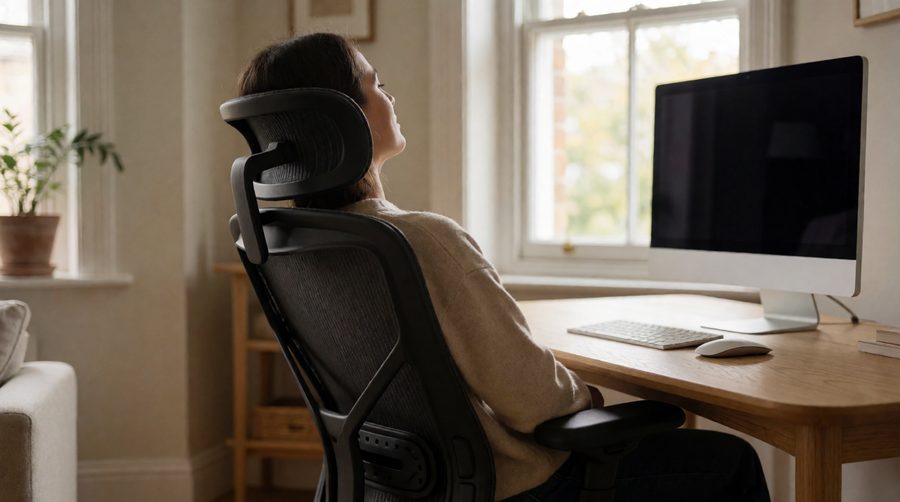
A high back office chair with head support earns its place if you:
If you always sit bolt upright and never lean back, it does very little, and a good mid-back office chair with strong lumbar support may suit you better. Have a look at our affordable ergonomic office chairs for options either way.
Not all head support is the same. The chairs in our range use four kinds, and the type matters more than the brand.
A separate pad on a stem that you can move. The "D" is the number of ways it adjusts:
More adjustment is only useful if the pad holds its position. Cheap stems can slowly slide down or flop back when you lean on them, the most common complaint in reviews.
Big executive office chairs, such as the Efomao 3008UK, Efomao 3084UK and EXCEBET 3043, have a tall back with a thick padded head section built in. There is nothing to adjust, so they are simple and they never wobble, but the cushion is in a fixed place. Sit in it first if you can, or check the back height against your own seated height.
Gaming-style chairs like the Anda Seat Novis Ultra, Flash Furniture X20 and the Costway massage chairs use a padded pillow strapped to the backrest. You can slide it up or down and take it off, and it is soft, but it can drift out of place and it pushes your head forward if it is too thick for you.
Racing-style chairs such as the Iconic Apollon have a tall 85cm back whose top section supports your head. It works as long as the back is tall enough for you. A "high back office chair" on its own is not a headrest, though: many high back chairs stop at shoulder height.
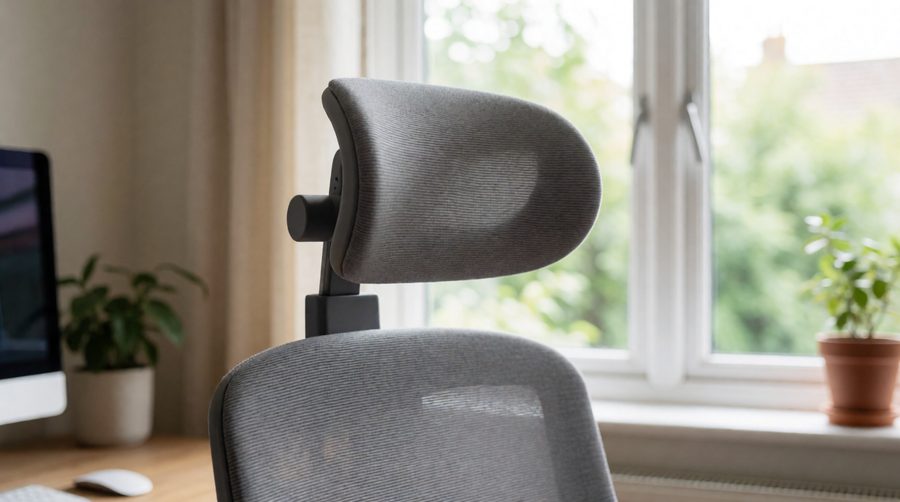
Head support in the wrong place is worse than none, because it pushes your head forward. Set it up like this:
Your head does not need to touch the pad while you type. Moving often matters more than any office chair: the NHS advice on neck pain is not to keep your neck in the same position for a long time, and the Chartered Society of Physiotherapy says staying still for long periods seems to matter more than posture itself.
Real figures from the office chairs in our range. Recline is the maximum backrest angle the chair lists; weight is the maximum user weight.
| Chair | Head support | Recline | Max weight | Upholstery | Extras |
|---|---|---|---|---|---|
| FLEXISPOT ErgoX | 3D adjustable | 135° | 130kg | Mesh | 5D lumbar, 6cm seat slide |
| Hbada E3 Ultra | 4D adjustable | - | - | Mesh back | 3-zone lumbar, 5-year frame warranty |
| Newtral NT002 | 2D adjustable | 126° | 136kg | Mesh back | Auto lumbar, footrest |
| Steelcase Please | Fitted, adjustable | 4 positions | - | Wool fabric | Seat depth, 12-year warranty |
| YERAIRR YR-7032 | Adjustable | 120° | 200kg | PU leather | Flip-up arms |
| Efomao 3008UK | Built-in cushion | 135° | 200kg | PU leather | Footrest |
| Efomao 3084UK | Built-in cushion | 3 positions | 200kg | Fabric | Footrest |
| EXCEBET 3043 | Built-in cushion | 135° | 180kg | Mesh | 57.5cm XXL seat, pocket springs |
| Anda Seat Novis Ultra | Pillow | 155° | 120kg | PVC leather | Fits users up to 210cm |
| Flash Furniture X20 | Pillow | 145° | 136kg | Faux leather | 81cm back |
| Costway massage chair | Removable pillow | 130° | 160kg | PU leather | Massage, footrest |
| mfavour MFV 38 | Pillow | 180° | 136kg | Leather | Lumbar cushion |
| Iconic Apollon | High back | 135° | 150kg | PU leather | 4D arms, 85cm back |
A dash means the listing doesn't give that figure.
For a full working day, a mesh ergonomic office chair with a movable head pad is the safest choice. The FLEXISPOT ErgoX pairs 3D head support with adaptive lumbar support and seat depth adjustment. That last one matters, because the pad only lines up with your head if you are sat right back in the seat.

The Newtral NT002 office chair has 2D head support, three lockable recline angles and a footrest that folds away under the seat. It is a good fit if you like to recline on calls or after lunch and still want proper support when you sit up to type.

The Efomao 3008UK and 3084UK are built like armchairs: a padded head cushion, a deep 60cm seat and a 200kg rating. They suit bigger users who want something soft rather than a fiddly adjustable pad. Our big and tall office chairs have more choice.
If you want a deep recline for gaming as well as work, the Flash Furniture X20 goes from 87 to 145 degrees and has both a head and a lumbar pillow. The Anda Seat Novis Ultra reclines even further, to 155 degrees, and is sized for users up to 210cm.
The head pad is only one part of the chair. A good office chair with headrest also needs:
Height is where head support matters most. On a fixed high back, check the backrest height: the Iconic Apollon's is 85cm, the Flash X20's 81cm and the Efomao 80cm. On an adjustable one, check how far the stem travels upwards. If you are well over six foot, look for chairs that list a maximum user height. The Anda Seat Novis Ultra lists 210cm.
Often, yes. Clip-on headrests are sold for many mesh office chairs, and popular models such as the Herman Miller Aeron have dedicated aftermarket ones. Universal kits clamp to the backrest frame, so check the backrest width and shape before you buy. A simple neck pillow is another cheap option. If your chair is worn out anyway, a new office chair with properly fitted head support is usually the better buy. Our computer chairs under £500 include several.
Better if you recline. It supports your head and neck when you lean back, which takes strain off your shoulders and adds comfort. If you always sit upright and never lean back, it adds little.
No. While you type, your head should be balanced over your shoulders and the pad can sit just behind it. It is there to take the weight when you lean back.
The pad should meet the base of your skull or the curve of your upper neck when you sit right back in the seat. Too low and it pushes your head forward; too high and it does nothing.
It can make reclining more comfortable, but no chair fixes neck pain on its own. The NHS advises keeping your neck moving and not holding it in one position for long, so take regular breaks. See a GP or physiotherapist if pain lasts.
For a few hours a day, yes. For full working days, an ergonomic office chair with adjustable head support, seat depth and adjustable arms usually fits better. Our black office chairs include both types.
A 3D pad moves up and down, forward and back, and tilts. A 4D one adds a second pivot so the pad can stay flat against your head at different recline angles.
